
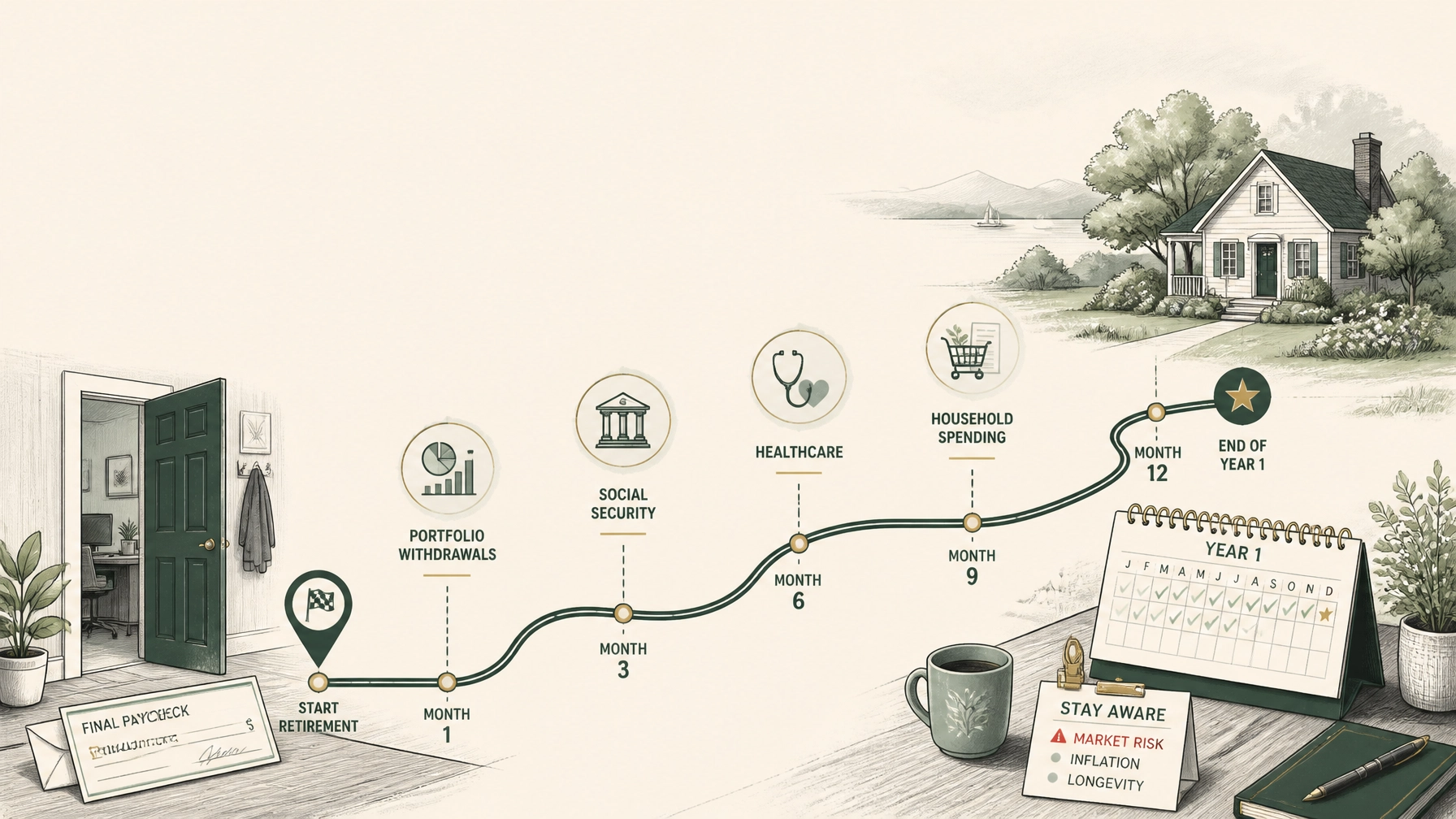
Image description: A clean financial illustration shows the first year of retirement as a connected timeline, with icons representing employment income, investments, Social Security, healthcare, and household expenses.
Retirement rarely begins with a single clean financial switch. Your salary may stop before Social Security begins. Healthcare premiums may change when employer coverage ends. Portfolio withdrawals may be small at first and larger later. Household spending may also shift as work-related costs disappear and travel, hobbies, or medical expenses increase.
That is why the first year of retirement deserves its own income map.
A retirement income map is a month-by-month view of where money will come from, when expenses will change, and how your portfolio may support the gap. It is not a prediction. It is a planning tool that helps you identify timing issues before they become stressful surprises.
Why the first year of retirement is different
During your working years, your paycheck usually arrives on a predictable schedule. Taxes, insurance premiums, and retirement contributions are often handled automatically. Once you retire, those systems may change at the same time.
Your first year could include:
- A final bonus, commission, or unused paid-time-off payment
- A partial year of salary
- A new pattern of portfolio withdrawals
- Social Security benefits that begin later in the year
- Employer health insurance ending before Medicare eligibility
- Medicare premiums and other healthcare expenses
- Changes in federal or state tax withholding
- Higher spending during the first months of newly available free time
The challenge is not simply determining how much you own. It is coordinating the timing of income and expenses while keeping portfolio risk aligned with your long-term goals.
Start with a month-by-month income calendar
Before your last paycheck, create a calendar covering at least the final three months of employment and the first twelve months of retirement.
List each expected cash flow by month:
| Income or expense | What to record |
|---|---|
| Salary | Last regular paycheck, bonus, commission, and unused leave payment |
| Portfolio withdrawals | Account source, gross amount, withholding, and expected deposit date |
| Social Security | Planned filing date and estimated monthly benefit |
| Pension income | Start date, payment frequency, and withholding |
| Healthcare | Premiums, deductibles, supplemental coverage, and out-of-pocket estimates |
| Household spending | Essential expenses, flexible spending, and irregular costs |
| Taxes | Expected withholding or estimated payments |
The goal is to distinguish between gross cash flow and spendable cash flow. A $5,000 portfolio distribution may not provide $5,000 for household spending if federal or state taxes are withheld.
This simple distinction can prevent a common planning error: comparing monthly expenses with income figures that are stated before taxes.

Image description: A financial planning illustration connects major retirement cash-flow categories into a clear household map, emphasizing coordination rather than a single source of income.
Separate essential spending from flexible spending
Your retirement budget should have more than one category. A single annual spending number can hide important differences in how expenses behave.
Consider dividing spending into three groups:
Essential spending
These are costs that generally continue regardless of market conditions:
- Housing
- Utilities
- Food
- Insurance
- Transportation
- Debt payments
- Basic healthcare costs
Flexible spending
These expenses may be adjusted if circumstances change:
- Dining out
- Entertainment
- Travel
- Gifts
- Recreation
- Home improvements
Irregular spending
These expenses may not appear every month but can affect the first retirement year:
- Vehicle replacement
- Major home repairs
- Family support
- Insurance deductibles
- Dental or vision costs
- Professional fees
- Relocation expenses
This structure helps you evaluate how much income must be dependable each month and how much spending can be adjusted if portfolio values fluctuate.
It also creates a more realistic conversation about retirement lifestyle. Many households spend less on commuting and work clothing after retirement, but they may spend more on travel, home projects, healthcare, or helping family members.
Coordinate benefits with the end of employment
Social Security is one part of the income map, but it may not begin when your salary ends.
The Social Security Administration states that retirement benefits can generally begin between ages 62 and 70. The amount depends partly on the age you claim, your earnings history, and your full retirement age. If you continue working while receiving benefits before full retirement age, an earnings test may affect payments in certain circumstances.
For 2026, the earnings limits are:
- $24,480 for someone under full retirement age for the entire year
- $65,160 for someone who reaches full retirement age during 2026, counting earnings before the month full retirement age is reached
- No earnings limit beginning with the month full retirement age is reached
These rules can be especially relevant for someone who retires gradually, works part time, or claims benefits during the same calendar year as employment income.
Review your Social Security earnings and retirement planning information and confirm the details that apply to your situation. Your income map should show the actual month benefits are expected to begin, not just an annual estimate.
Plan for the healthcare gap
Healthcare is one of the most important transition-year expenses because coverage may change before Medicare begins.
If you retire before age 65, determine how you will obtain coverage between the end of employer insurance and Medicare eligibility. If you retire at or after 65, confirm enrollment timing and the cost of the coverage you select.
Medicare costs are not limited to one monthly premium. According to Medicare.gov, the standard Part B premium is $202.90 per month in 2026, and the annual Part B deductible is $283. Some beneficiaries pay more based on income. Medicare Advantage, Part D, Medigap, and other coverage choices have different premiums and cost-sharing structures.
You can review the official Medicare costs page when building your estimate.
Your income map should include:
- The final month of employer-sponsored coverage
- The first month of replacement coverage
- Medicare enrollment dates, if applicable
- Monthly premiums
- Deductibles and coinsurance
- Prescription costs
- Expected out-of-pocket spending
Do not assume that healthcare costs will remain level throughout the year. A deductible or major procedure can create a large one-time expense.
Establish a withdrawal schedule, not just a withdrawal amount
A portfolio withdrawal plan should answer more than, “How much can we take out?”
It should also address:
- Which account provides the cash
- When the distribution is requested
- How much is withheld for taxes
- Whether the withdrawal is monthly, quarterly, or occasional
- How the plan changes if spending is higher or lower than expected
- How portfolio risk relates to near-term spending needs
For example, a household may choose monthly withdrawals for regular expenses and keep a separate cash reserve for irregular bills. Another household may use quarterly distributions because income arrives from several sources. There is no single schedule that fits every retiree.
The key is to make the schedule deliberate rather than reacting to each expense as it appears.
A periodic portfolio review can help determine whether the portfolio remains aligned with the household’s objectives, time horizon, income needs, and tolerance for volatility. Diversification and proper position sizing may also matter more once withdrawals begin, because investment losses and withdrawals can occur at the same time.
Review tax withholding after the paycheck ends
Retirement can change how taxes show up in your cash flow because salary may be replaced by a combination of portfolio distributions, Social Security, pension income, interest, dividends, and capital gains.
The IRS explains in Publication 505 for 2026 that federal income taxes are generally paid through withholding, estimated tax payments, or a combination of both. Tax may be withheld from pensions, certain retirement distributions, and Social Security benefits when requested.
When your employment ends, it can be helpful to note:
- The amount already withheld from wages
- Withholding on pension or retirement payments
- Whether portfolio distributions may have tax implications
- Whether estimated payments could become relevant
- Whether a large final paycheck or bonus changes the year’s income
- Whether a qualified tax professional suggests a projection for your situation
This is a high-level planning consideration, not a tax recommendation. Tax treatment depends on the household’s circumstances. For questions about withholding, estimated payments, or the tax effect of retirement income, consult a qualified tax professional.
A practical example
Suppose Elena plans to retire in June. Her final paycheck arrives in July because her employer pays one pay period in arrears. She plans to begin Social Security in October and expects Medicare coverage to begin in August.
Her transition-year map might show:
- Salary through July
- No salary in August and September
- Portfolio withdrawals beginning in August
- Social Security beginning in October
- Medicare premiums beginning in August
- Higher spending in the first three months for travel and home repairs
Without a calendar, Elena might think she has enough annual income because her salary covers much of the year. But her monthly cash flow could be tight in August and September, followed by a change in October when benefits begin.
The map does not tell her exactly what to buy or sell. It identifies the timing gap so she can evaluate liquidity, withdrawal amounts, and portfolio risk before leaving work.

Image description: A sophisticated calendar illustration divides the first retirement year into planning periods, showing when to review income, healthcare, withdrawals, and spending.
Review the map at 30, 90, and 180 days
Your first plan will be based partly on estimates. That is normal. Review it after retirement begins.
After 30 days
Compare actual deposits and expenses with your assumptions. Check whether the timing of your final paycheck, benefit payments, and insurance premiums matched expectations.
After 90 days
Review spending patterns. Newly retired households often learn that some expenses are lower than expected while others are higher. Adjust the flexible portion of the budget if needed.
After 180 days
Evaluate the broader picture:
- Is the withdrawal schedule working?
- Are portfolio distributions arriving as planned?
- Has healthcare spending changed?
- Does your current cash-flow setup still appear coordinated?
- Has your comfort with portfolio volatility changed?
- Does your investment allocation still match your needs?
These reviews are not attempts to forecast markets. They are opportunities to keep the plan connected to reality. If tax questions come up during these reviews, consult a qualified tax professional for guidance specific to your circumstances.
The key takeaway
Your first year of retirement is a transition period, not simply the first year without a paycheck. A month-by-month income map can help you coordinate salary, portfolio withdrawals, benefits, healthcare, taxes, and household spending before the transition begins.
If you are approaching retirement, a fiduciary investment adviser can help you organize the moving parts, evaluate portfolio risk, and connect your investment strategy with your income needs. You can schedule a 15-minute conversation with Portafolio Capital Management, learn more about the firm, or call (512) 593-8380.
Sources
- Social Security Administration: Plan for Retirement
- Social Security Administration: Receiving Benefits While Working
- Medicare.gov: Medicare Costs in 2026
- Internal Revenue Service: Publication 505, Tax Withholding and Estimated Tax for 2026
- Portafolio Capital Management Investment Blog
Portafolio Capital Management LLC dba Mau Sanchez Capital is a Texas-registered investment adviser. This content is provided for informational and educational purposes only and does not constitute personalized investment advice, tax advice, legal advice, or a solicitation to buy or sell any security. Investing involves risk, including the possible loss of principal. Advisory services are provided only pursuant to a written advisory agreement. Past performance is not indicative of future results.
Leave a Reply