
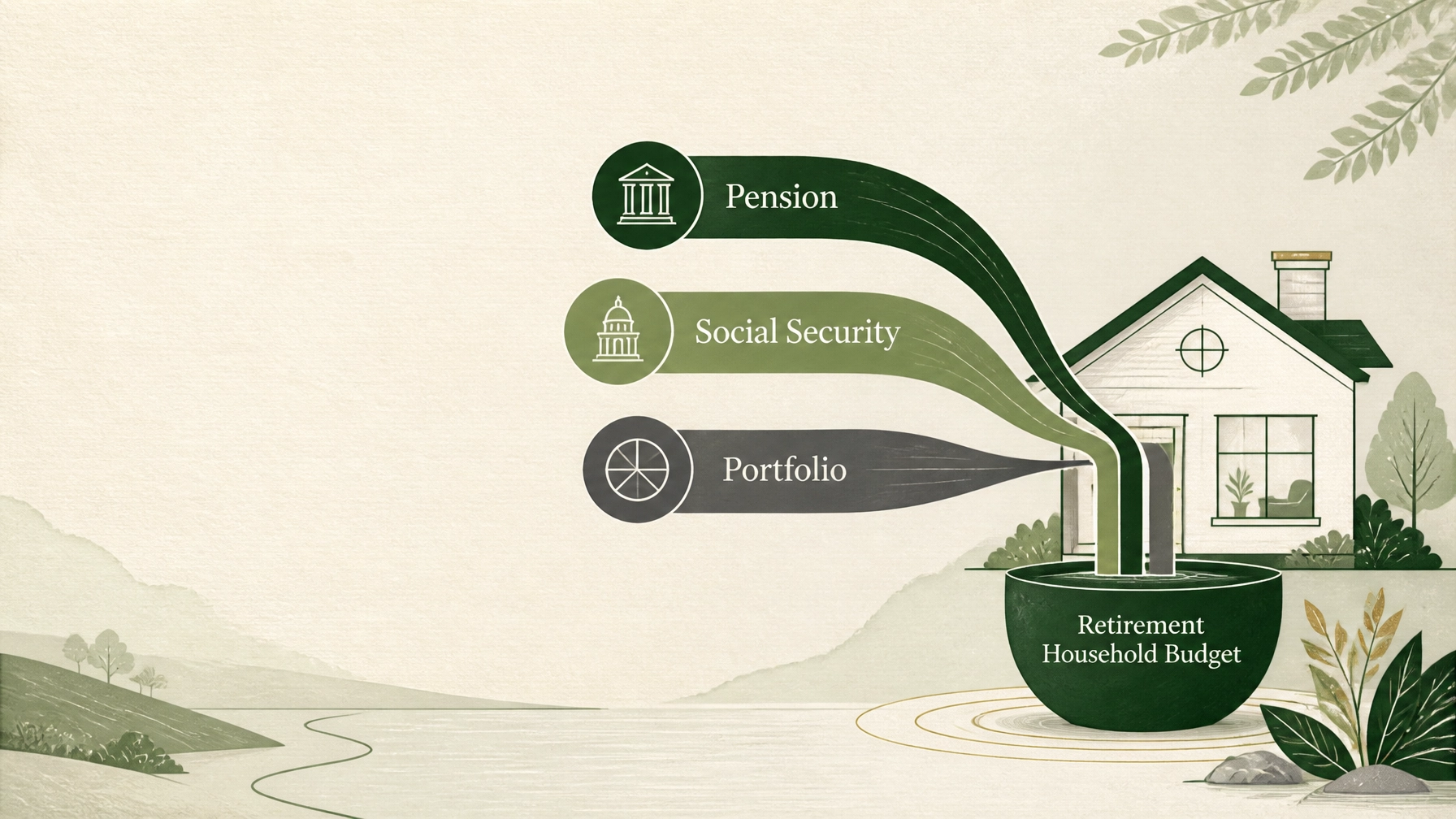
Retirement income is rarely as simple as replacing one paycheck with one monthly benefit. For households with a pension, Social Security, and investment accounts, the more important question is often:
How should these three income sources work together over time?
A pension may provide steady income, Social Security may offer a lifetime benefit that can increase when delayed, and a portfolio can provide liquidity for changing expenses. Each source serves a different purpose. Coordinating them can help a household manage cash flow, portfolio risk, and financial flexibility throughout retirement.
There is no single strategy that works for everyone. The right approach depends on pension rules, household spending, health, marital status, portfolio size, and the timing of other income.
The three roles of retirement income
Before deciding when to begin each income source, it helps to understand what each one contributes.
1. Pension income provides structure
A pension usually provides a recurring monthly benefit based on factors such as salary and years of service. The pension may begin immediately at retirement or offer different starting dates and payment options.
Important questions include:
- Does the pension provide a survivor benefit for a spouse?
- Is the monthly benefit reduced if a joint-and-survivor option is selected?
- Does the benefit change depending on the start date?
- Is the pension adjusted periodically, or does the payment remain generally fixed?
- What happens to the benefit after the participant dies?
A pension can form the foundation of a retirement income plan, but it may not cover every expense. It also may not provide the flexibility needed for large, irregular costs.
2. Social Security provides timing flexibility
Social Security retirement benefits can generally begin as early as age 62. Claiming before full retirement age results in a permanently reduced monthly benefit. Delaying benefits after full retirement age can increase the monthly benefit until age 70 for eligible workers.
The Social Security Administration’s retirement resources provide estimates and general information about claiming ages and benefits.
For some households, delaying Social Security may create a stronger source of income later in life. For others, beginning benefits earlier may be reasonable because of health considerations, immediate cash-flow needs, or a desire to reduce portfolio withdrawals.
For married couples, the higher earner’s benefit deserves particular attention. That benefit may influence the surviving spouse’s future income, so the claiming decision can affect more than the first person to file.
3. The portfolio provides flexibility
An investment portfolio can help fill income gaps, pay for discretionary spending, and fund expenses that do not occur every month.
Examples include:
- Home repairs
- Vehicle purchases
- Family assistance
- Travel
- Long-term care needs
- Major charitable gifts
- Unexpected medical or household expenses
Unlike a pension or Social Security, a portfolio is exposed to market volatility. Withdrawals also reduce the amount remaining for future spending and growth.
That makes the portfolio valuable not only for income, but also for flexibility and liquidity.
Coordinate the timing, not just the amounts
Many retirement plans focus on the annual amount of income. A stronger plan also considers when each income source begins and how the transition affects the portfolio.

Consider a hypothetical couple, Elena and David. Elena retires at age 65 with a pension that covers most of their basic monthly expenses. David is eligible for Social Security but is considering delaying his benefit. The couple also has investment accounts they can use for discretionary spending and the gap before Social Security begins.
Their plan might include:
- Starting Elena’s pension when she retires.
- Using a measured portfolio withdrawal to cover selected expenses.
- Delaying David’s Social Security benefit if their cash flow and portfolio can support the decision.
- Using the larger future Social Security benefit to reduce reliance on the portfolio later.
This is not automatically the best choice for every household. Delaying Social Security may require greater portfolio withdrawals during the early years of retirement. The decision should be evaluated against market conditions, spending needs, health, and the couple’s ability to tolerate uncertainty.
The key is to assess the three income sources as one system rather than making each decision separately.
Build an income floor for essential expenses
A useful starting point is to separate spending into two categories:
- Essential expenses: Housing, food, utilities, insurance, transportation, and other costs that are difficult to postpone.
- Flexible expenses: Travel, gifts, entertainment, renovations, and other spending that can be adjusted.

Pension and Social Security may cover part or all of the essential expenses. The portfolio can then serve as a flexible source for discretionary spending and unexpected costs.
If guaranteed income does not cover the household’s core expenses, the portfolio may need to provide a larger and more consistent withdrawal. That can increase the importance of liquidity, diversification, and a disciplined withdrawal process.
If guaranteed income covers most basic expenses, the portfolio may have more room to support long-term growth and discretionary goals. However, that does not eliminate market risk. A portfolio still needs to reflect the household’s time horizon and tolerance for volatility.
Liquidity matters during the transition
Liquidity means having access to money when needed without relying on the sale of long-term investments at an unfavorable time.
Liquidity is especially important when:
- Retirement begins before Social Security.
- A pension has a delayed start date.
- A household expects a large purchase.
- One spouse continues working while the other retires.
- The pension does not cover all monthly expenses.
- The household wants flexibility during a period of market uncertainty.
A portfolio designed only around long-term growth may not be well suited for near-term withdrawals. On the other hand, holding too much in low-growth assets for too long can limit the portfolio’s ability to support later retirement spending.
The goal is not to eliminate risk. It is to align the amount and type of risk with the timing of withdrawals.
How income timing affects portfolio risk
Early retirement can create a vulnerable period for investors. If the portfolio declines while withdrawals are being made, the household may have fewer assets available to participate in a future recovery. This is commonly called sequence risk, meaning the order of investment returns can affect the sustainability of withdrawals.
Coordinating income sources can help manage this risk in several ways:
- Use pension income for recurring expenses when appropriate.
- Avoid unnecessary portfolio withdrawals when other income is sufficient.
- Maintain liquid assets for near-term spending.
- Review the portfolio’s allocation as the retirement date approaches.
- Keep discretionary spending flexible during difficult market periods.
- Revisit the plan when pension, Social Security, or household circumstances change.

A portfolio review should not focus only on expected returns. It should also ask how much the household may need to withdraw, from which accounts, and under what market conditions.
Pension choices can affect the surviving spouse
A pension election is often an important household decision, not just an individual one. A single-life option may provide a larger monthly payment while the participant is alive, but it may provide less income for a surviving spouse. A joint-and-survivor option may reduce the initial benefit while continuing some income after the participant’s death.
The choice can affect:
- The surviving spouse’s monthly cash flow
- The amount the portfolio may need to provide
- The timing of Social Security decisions
- The household’s ability to manage future expenses
- The level of financial independence for each spouse
Before making a pension election, households should review the available options and consider how the decision fits with Social Security and portfolio assets. Pension administrators can explain plan provisions, while a qualified financial professional can help evaluate how the choice interacts with the broader retirement plan.
Review the tax interaction carefully
Pension income, Social Security benefits, and withdrawals from retirement accounts can interact in ways that affect a household’s taxable income. The IRS explains in Publication 915 that pension income and other income are considered when determining whether part of Social Security benefits may be taxable.
This does not mean taxes should drive every retirement income decision. It does mean that taxes are one factor households may want to understand as they evaluate overall cash flow.
A general review may include:
- Expected pension income
- Social Security benefits
- Withdrawals from traditional retirement accounts
- Taxable investment income
- Roth and taxable account resources
- Required distributions when applicable
Because tax rules are complex and may change, readers should consult a qualified tax professional for questions about their specific situation.
A practical coordination checklist
Before retirement or during an annual review, consider organizing the following information:
Pension
- Monthly benefit under each available start date
- Survivor benefit options
- Any adjustments or restrictions
- Pension administrator contact information
Social Security
- Estimated benefit at different claiming ages
- Full retirement age
- Spousal and survivor implications
- Earnings history and benefit estimate
Portfolio
- Account balances by account type
- Current asset allocation
- Expected withdrawal needs
- Liquid reserves
- Large planned expenses
- Investment risk relative to the household’s time horizon
Household plan
- Essential monthly expenses
- Flexible annual spending
- Debt obligations
- Health and longevity considerations
- Income needs for the surviving spouse
- A process for reviewing the plan periodically
The main takeaway
A pension, Social Security, and investment portfolio can each play a valuable role in retirement. The challenge is coordinating their timing and purpose.
Pension income may provide a foundation. Social Security may offer flexibility in when income begins and how much is received later. The portfolio can provide liquidity, growth potential, and support for expenses that guaranteed income does not cover.
A thoughtful retirement income plan considers all three sources together, with attention to cash flow, portfolio risk, liquidity, survivor needs, and changing circumstances.
If you would like to discuss how your pension, Social Security, and portfolio may fit together, schedule a conversation with a fiduciary financial adviser or visit Portafolio Capital Management dba Mau Sanchez Capital. A conversation can help clarify the trade-offs without committing you to a particular investment outcome.
Sources
- Social Security Administration: Retirement Benefits
- Social Security Administration: Social Security Fairness Act
- Internal Revenue Service: Publication 915, Social Security and Equivalent Railroad Retirement Benefits
- Portafolio Capital Management: Strategy
- Portafolio Capital Management: Risk Analysis
Portafolio Capital Management LLC dba Mau Sanchez Capital is a Texas-registered investment adviser. This content is provided for informational and educational purposes only and does not constitute personalized investment advice, tax advice, legal advice, or a solicitation to buy or sell any security. Investing involves risk, including the possible loss of principal. Advisory services are provided only pursuant to a written advisory agreement. Past performance is not indicative of future results.
Leave a Reply