A weaker hiring environment can make an approaching retirement feel less predictable. If your employer freezes hiring, reduces hours, delays promotions, or becomes more selective about retaining experienced workers, the date you expected to retire may no longer feel entirely within your control.
But should a national hiring slowdown automatically change your personal retirement date?
Not necessarily. Current labor-market data may be a useful reason to review your assumptions, but it is not, by itself, a personal retirement recommendation or a reliable forecast of what will happen next. The more important question is whether your financial plan can withstand a longer transition from employment income to portfolio withdrawals.
What the latest labor-market data show
As of September 2, 2026, the most recent official monthly employment report from the U.S. Bureau of Labor Statistics covers July. The August Employment Situation report is scheduled for release on September 4, so August payroll and unemployment figures are not yet official.
The July data showed:
- Nonfarm payroll employment decreased by 23,000.
- The unemployment rate was 4.1%.
- Labor-force participation was 61.4%.
- May payroll growth was revised to 63,000 from an earlier estimate of 129,000.
- June payroll growth was revised to 20,000 from an earlier estimate of 57,000.
These revisions matter because employment data are updated as more information becomes available. They also reinforce the importance of distinguishing between an initial headline and the broader trend.
The latest BLS Job Openings and Labor Turnover Survey, released September 1 and covering July, reported approximately 7.3 million job openings and 5.1 million hires. The figures were described as little changed.
Additional analysis from Indeed Hiring Lab’s August 2026 labor-market snapshot described a “low-hire, low-fire” environment. Hiring, quits, and layoffs have remained subdued. Job postings were near their pre-pandemic baseline, while posted wage growth was 2.5% year over year through July.
Taken together, these figures suggest a labor market that is cooling and becoming more selective, rather than one that has clearly collapsed. Forecasts and commentary about future hiring should be treated as estimates, not established facts.
Why employment uncertainty matters near retirement
Employment income often provides more than a paycheck. It may also help you:
- Continue saving for retirement
- Pay health insurance premiums
- Delay withdrawals from investment accounts
- Postpone claiming Social Security
- Replenish cash reserves
- Cover large household expenses without selling investments
If employment becomes less reliable, several retirement-planning decisions may arrive earlier than expected.
For example, an individual who planned to work until age 67 may have expected three more years of salary, retirement contributions, and employer health benefits. A layoff, reduced schedule, or difficult job search could shorten that runway.
This does not mean every worker should delay retirement. It does mean that retirement timing should be tested against more than a single planned date.
The first question: How dependent is your plan on continued employment?
Start by identifying which parts of your retirement plan require your current paycheck to continue.
Consider:
- Essential expenses: Which costs must be paid regardless of market conditions?
- Discretionary expenses: Which expenses could be reduced temporarily if employment ended earlier?
- Healthcare costs: What would happen if employer coverage ended before Medicare eligibility?
- Debt obligations: Would mortgage, credit, or other payments limit your flexibility?
- Savings contributions: How much additional retirement savings depends on future earnings?
- Social Security timing: Would an earlier retirement affect when you claim benefits?
- Portfolio withdrawals: How much would you need to withdraw if your paycheck stopped?
This exercise can reveal whether your planned retirement date is financially durable or depends on several assumptions working perfectly.
Liquidity becomes more important when the job market slows
Liquidity means having access to money when you need it without relying on a favorable market price or a lengthy transaction process.
An employment interruption can create a liquidity challenge because expenses continue while income falls. At the same time, selling investments to pay bills may become uncomfortable if markets are volatile.
A practical review should identify the resources available for near-term spending, such as:
- Cash savings
- Expected severance or deferred compensation
- Taxable investment accounts
- Retirement account distributions
- Part-time or consulting income
- Social Security or pension income
The goal is not to hold every retirement asset in cash. Excessive cash can create its own long-term tradeoffs. The goal is to understand how expenses would be funded if employment ended several months or years earlier than planned.
Portafolio Capital Management’s risk analysis approach emphasizes the importance of aligning portfolio risk with objectives, time horizon, income needs, and tolerance for volatility. Employment uncertainty is one of the personal factors that can change those inputs.
Earlier withdrawals can affect portfolio risk
Portfolio withdrawals are different from contributions.
When you are working, a market decline may reduce the value of your investments, but continued earnings can allow you to keep saving and avoid selling. When you are withdrawing from a portfolio, selling investments during a decline can make it more difficult for the portfolio to recover.
This is often called sequence-of-returns risk. It refers to the possibility that poor investment returns early in retirement can have a larger effect when withdrawals are occurring at the same time.
Consider a hypothetical investor, Elena. She planned to retire at 65 after receiving two more years of salary and retirement contributions. Instead, her employer offers a separation package at 63.
Elena now has several choices to evaluate:
- Continue searching for comparable employment
- Accept part-time work
- Use cash reserves temporarily
- Begin portfolio withdrawals
- Change planned spending
- Revisit the timing of Social Security
- Retire earlier than expected
None of these decisions should be made solely because payroll growth was weak in a particular month. But the change in employment circumstances may justify reviewing the amount, timing, and source of withdrawals.
Do not confuse a low unemployment rate with an easy job search
The unemployment rate remains an important measure, but it does not tell the entire story for an individual approaching retirement.
A national unemployment rate can remain relatively low while experienced workers face:
- Longer job searches
- Fewer openings in their specific field
- More selective hiring
- Lower compensation offers
- Greater use of contract or temporary work
- Less negotiating power
- Geographic limitations
The Indeed Hiring Lab report noted that overall job postings were close to their pre-pandemic level, but conditions varied significantly by occupation. A broad labor-market statistic may not reflect the experience of a professional in a particular industry, location, or age group.
For retirement planning, this means the relevant question is not simply, “Is the unemployment rate low?” It is also, “How realistic is it for me to replace my income if I need to?”
A retirement date should be a range, not just a single number
Many households plan around one retirement date. A more resilient approach is to consider a range:
- Preferred date: When you would retire if circumstances remain favorable
- Early date: When you might retire if employment ends unexpectedly
- Later date: When you might continue working if additional savings or income flexibility is needed
For each date, review:
- Projected spending
- Reliable income
- Portfolio withdrawal requirements
- Health insurance coverage
- Cash reserves
- Investment allocation
- High-level tax and legal considerations, with individual guidance from qualified professionals
- Lifestyle priorities
This does not require predicting the labor market. It requires understanding how your household would respond to different employment outcomes.
A checklist for reviewing your retirement timing
A hiring slowdown may be a useful prompt to revisit these questions:
1. Could you cover essential expenses if your paycheck stopped?
Estimate the amount needed for housing, food, insurance, healthcare, transportation, and other required costs.
2. How long could your liquid reserves last?
Calculate how many months of essential expenses could be covered without selling long-term investments.
3. Would your portfolio support a temporary income gap?
Consider the effect of withdrawals if employment ended before your preferred retirement date.
4. Is your investment strategy aligned with your time horizon?
Your portfolio may need to support both near-term spending and long-term growth. Those objectives should be considered together.
5. What decisions would become irreversible?
Claiming benefits, accepting a buyout, selling concentrated investments, or changing housing can have lasting consequences. Major decisions deserve careful analysis rather than a rushed response to headlines. Readers with tax-related questions about these decisions should consult a qualified tax professional.
6. Have you discussed multiple scenarios?
A fiduciary investment adviser can help organize assumptions, evaluate tradeoffs, and review whether your portfolio strategy remains aligned with your goals. The purpose is not to predict the next labor-market report. It is to make your financial decision-making more deliberate and focused on broad retirement-planning considerations rather than product-driven decisions.
The bottom line
The 2026 hiring slowdown does not automatically mean you should delay retirement. It also should not be dismissed if your plan depends heavily on several more years of uninterrupted employment.
The latest data point to slower hiring and a more cautious labor market, but August employment figures are not yet official as of September 2, 2026. The most useful response is to review your personal financial runway, liquidity, withdrawal strategy, and portfolio risk under more than one retirement timeline.
If employment uncertainty has made your retirement date less clear, schedule a conversation with Portafolio Capital Management dba Mau Sanchez Capital or call (512) 593-8380. A review can help you better understand your options without assuming that any particular market or employment outcome is certain. For questions about your individual tax situation, consult a qualified tax professional.
Sources
- U.S. Bureau of Labor Statistics, July 2026 Employment Situation
- U.S. Bureau of Labor Statistics, Job Openings and Labor Turnover Survey
- U.S. Bureau of Labor Statistics, August 2026 preliminary benchmark revision
- Indeed Hiring Lab, U.S. Labor Market Snapshot, August 2026
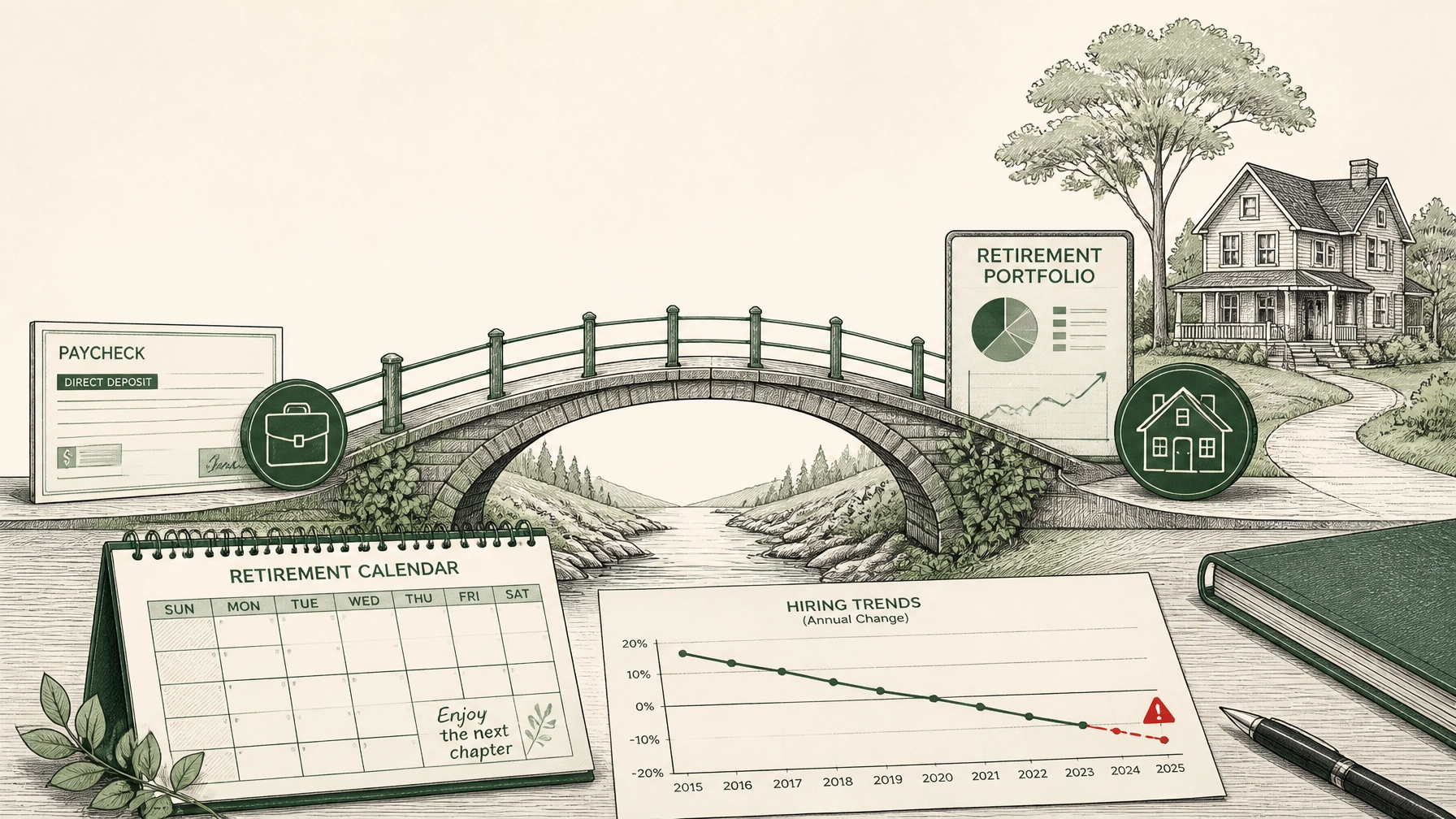
Image description: Original editorial illustration using a dark green, cream, sage, charcoal, and light gray palette. A retirement calendar and slowing hiring chart are connected by a bridge between employment income and a retirement portfolio. The illustration is conceptual, educational, and contains no realistic people or third-party branding.
Portafolio Capital Management LLC dba Mau Sanchez Capital is a Texas-registered investment adviser. This content is provided for informational and educational purposes only and does not constitute personalized investment advice, tax advice, legal advice, or a solicitation to buy or sell any security. Investing involves risk, including the possible loss of principal. Advisory services are provided only pursuant to a written advisory agreement. Past performance is not indicative of future results.
Leave a Reply