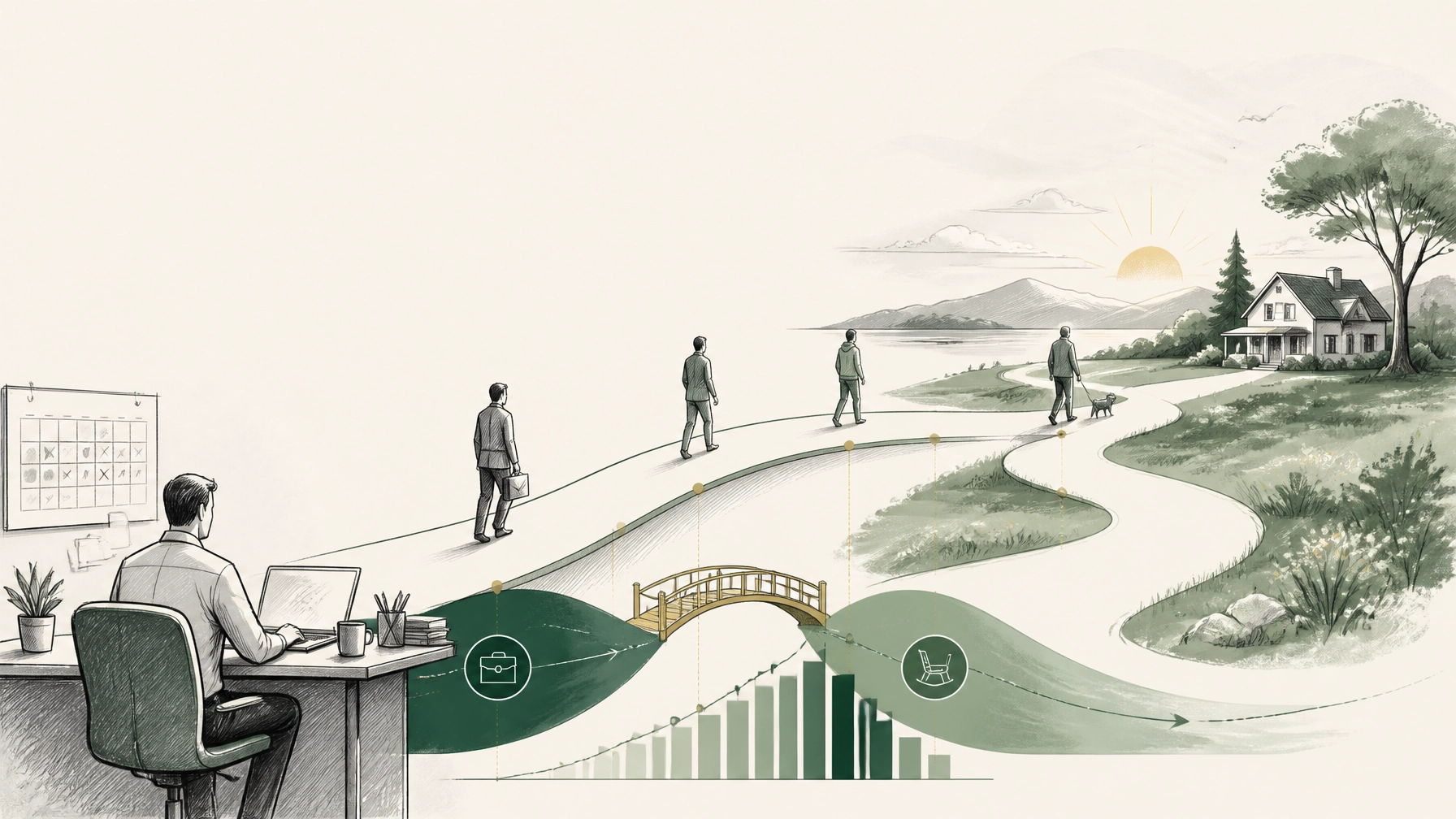
An editorial illustration showing how work income, portfolio withdrawals, and retirement goals can connect during a gradual transition.
Retirement does not always begin with a final paycheck and a complete stop to work. For many people, the transition is gradual. They reduce their hours, accept consulting projects, start a part-time role, or continue working in a business while drawing some income from their portfolio.
This period can create valuable flexibility, but it also requires careful coordination. Your employment income may change from year to year. Your spending needs may evolve. Social Security timing may become more complicated. Meanwhile, your portfolio may need to support withdrawals without taking more risk than your long-term plan can tolerate.
A phased retirement plan can help connect these moving parts.
What is phased retirement?
Phased retirement is a gradual transition from full-time employment to retirement. It may involve:
- Reducing your work schedule
- Moving from an employee role to consulting
- Working seasonally or on specific projects
- Continuing to operate a business with fewer responsibilities
- Taking a part-time position after leaving a full-time career
- Beginning limited portfolio withdrawals before completely leaving the workforce
The goal is not simply to work longer. It is to create a transition that aligns your time, income, portfolio, and lifestyle with your retirement objectives.
For some households, part-time income covers essential expenses. For others, it pays for discretionary spending while the portfolio remains invested. In either case, earned income can reduce the amount you need to withdraw from investments during the early years of retirement.
That matters because the first years of portfolio withdrawals can be especially sensitive to market conditions.
Why the transition years deserve special attention
When you are working full time, a market decline may be uncomfortable, but your paycheck can continue covering most of your expenses. Once withdrawals begin, the same decline can have a greater effect on your financial plan.
Sequence-of-returns risk is the possibility that poor investment returns early in retirement, combined with withdrawals, may damage a portfolio more than the same returns occurring later. Selling investments after a decline can leave fewer assets available to participate in a future recovery.
Phased work may help reduce this risk by lowering the size of early withdrawals.
Consider a simplified example:
- A household spends $90,000 per year.
- Part-time consulting produces $35,000 after ordinary business expenses.
- Social Security has not yet started.
- The portfolio provides the remaining $55,000, before other planning adjustments.
If consulting income increases to $50,000, the portfolio withdrawal may fall to $40,000. That difference may appear modest, but maintaining more invested assets during a difficult market period can give the household more flexibility.
Any income change may also have tax implications depending on the source of income and the household’s overall situation. For questions about how these rules apply in your circumstances, consult a qualified tax professional.
The example is hypothetical and does not establish a recommended withdrawal amount. It illustrates why income planning and portfolio management should be considered together.

An educational illustration showing how several income sources can support a household during the transition into retirement.
Start with a spending map, not a withdrawal percentage
A common mistake is to begin with a target withdrawal rate before understanding how spending may change.
Instead, divide projected expenses into three categories:
1. Essential expenses
These are costs that are difficult to reduce quickly, such as:
- Housing
- Utilities
- Food
- Insurance premiums
- Transportation
- Healthcare
- Debt payments
2. Flexible expenses
These may change depending on markets, work income, or other circumstances:
- Travel
- Dining out
- Gifts
- Hobbies
- Home improvements
- Large purchases
3. Irregular expenses
These may not occur every month but can have a meaningful effect on the portfolio:
- Vehicle replacement
- Major home repairs
- Family support
- Relocation
- Extended travel
- Unexpected healthcare costs
This framework helps distinguish the income required to maintain basic stability from the income that supports lifestyle choices. It also gives you a starting point for deciding which expenses could be delayed if markets decline.
Decide how work income fits into the plan
Consulting and part-time income may be less predictable than a traditional salary. Before relying on it, evaluate:
- How long the work is likely to continue
- Whether compensation is steady or project-based
- Whether the income is before or after business expenses
- Whether health insurance or other benefits continue
- Whether the work requires travel, equipment, or professional costs
- How much of the income should be treated as a reserve rather than spent immediately
It may be helpful to separate recurring income from occasional income. A consulting contract that is renewed annually should not necessarily be treated the same as a guaranteed paycheck.
One approach is to use predictable work income for a portion of recurring expenses while directing irregular income toward a reserve, planned purchases, or portfolio replenishment. The appropriate structure depends on the household’s circumstances.
Coordinate Social Security with continued work
If you are receiving Social Security retirement benefits while working, the earnings test may apply before you reach full retirement age.
For 2026, the Social Security Administration states that:
- If you are under full retirement age for all of 2026, benefits may be reduced by $1 for every $2 earned above $24,480.
- If you reach full retirement age in 2026, the higher earnings limit is $65,160 for earnings before the month you reach full retirement age, with $1 withheld for every $3 above that limit.
- After reaching full retirement age, there is no earnings limit on wages or self-employment income.
The earnings test generally considers wages and net earnings from self-employment. Investment income, pensions, and interest are treated differently under these rules. You can review current details through the Social Security Administration’s guidance on receiving benefits while working.
The earnings test is only one part of the decision. You also need to consider whether claiming benefits earlier or delaying them fits your broader income plan, health considerations, household circumstances, and longevity expectations. The SSA explains delayed retirement credits in its retirement planning resources.
Because Social Security decisions can be personal and consequential, consider reviewing your specific situation with an appropriately qualified professional.
Align portfolio withdrawals with changing income
A phased retirement plan usually works best when portfolio withdrawals are treated as adjustable rather than automatic.
For example, you might establish:
- A baseline withdrawal amount for essential spending
- A flexible amount for discretionary expenses
- Conditions that would lead you to pause or reduce optional withdrawals
- A process for reviewing the plan after significant market changes
- A reserve for near-term spending needs
This is different from trying to predict the market. It is a way to establish decision rules before emotions become part of the decision.
A portfolio may also be organized by time horizon:
- Near-term assets: Money intended for upcoming expenses and emergencies
- Intermediate assets: Investments that may support spending in the next several years
- Long-term assets: Diversified growth-oriented investments intended for later retirement needs
This type of structure does not eliminate market risk. It can, however, help clarify which assets are intended for which purpose.

An illustration of how early market declines and withdrawals can affect a retirement portfolio, and why reserves and flexibility matter.
Review asset allocation as your paycheck changes
Asset allocation is the mix of investments held across a portfolio. It should reflect your objectives, time horizon, income needs, and tolerance for volatility.
When work income declines, your portfolio may become more important to your financial plan. That does not automatically mean your portfolio should become extremely conservative. It does mean the risk level deserves a careful review.
Questions to consider include:
- How much of the portfolio may be needed within the next few years?
- How much income is expected from work, Social Security, or other sources?
- Can discretionary spending be reduced during a prolonged market decline?
- Is the portfolio diversified across appropriate asset classes?
- Are individual positions or sectors too large relative to the overall portfolio?
- When was the last formal review of the target allocation?
Diversification can reduce the impact of relying too heavily on one investment or market segment, but it cannot prevent losses. The Securities and Exchange Commission provides an overview of asset allocation, diversification, and rebalancing.
Do not overlook employer benefits and account rules
Reducing hours may affect benefits in ways that are not immediately obvious. Before changing your work schedule, ask your employer or human resources department about:
- Health insurance eligibility
- Retirement plan participation
- Employer matching contributions
- Vesting requirements
- Paid time off
- Disability or other workplace benefits
- Classification as an employee or independent contractor
If you continue contributing to an employer retirement plan, review the plan’s rules and current IRS limits. The IRS provides information on retirement-plan contributions and elective deferral limits.
Income from wages, self-employment, taxable investments, and retirement accounts may be treated differently under tax rules. This article includes only general educational information and does not provide tax advice. For guidance specific to your situation, consult a qualified tax professional.
Build an annual transition review
A gradual exit from work is not a one-time decision. It is a process that may require periodic adjustments.
At least annually, review:
- Actual spending compared with your original estimate
- Consulting or part-time income
- Portfolio withdrawals
- Social Security status
- Healthcare and employer benefits
- Asset allocation and diversification
- Cash and short-term reserves
- Changes in your retirement timeline
- Major family, housing, or lifestyle decisions
A review is also appropriate after a significant change, such as a lost contract, extended illness, major market decline, unexpected family obligation, or decision to retire completely.
The key takeaway
Work and retirement do not have to be separate financial phases. A thoughtfully managed transition can allow employment income, portfolio withdrawals, Social Security timing, and investment risk to work together.
The central question is not simply, “How much can I withdraw?” It is, “How should my income sources and portfolio adapt as my work changes?”
A fiduciary investment adviser can help evaluate those moving parts within the context of your objectives, time horizon, and risk tolerance. To discuss your transition into retirement, schedule a 15-minute conversation with Portafolio Capital Management, visit Portafolio Capital Management dba Mau Sanchez Capital, or call (512) 593-8380.
For additional educational resources, visit the Portafolio Capital investment blog.
Portafolio Capital Management LLC dba Mau Sanchez Capital is a Texas-registered investment adviser. This content is provided for informational and educational purposes only and does not constitute personalized investment advice, tax advice, legal advice, or a solicitation to buy or sell any security. Investing involves risk, including the possible loss of principal. Advisory services are provided only pursuant to a written advisory agreement. Past performance is not indicative of future results.
Leave a Reply