
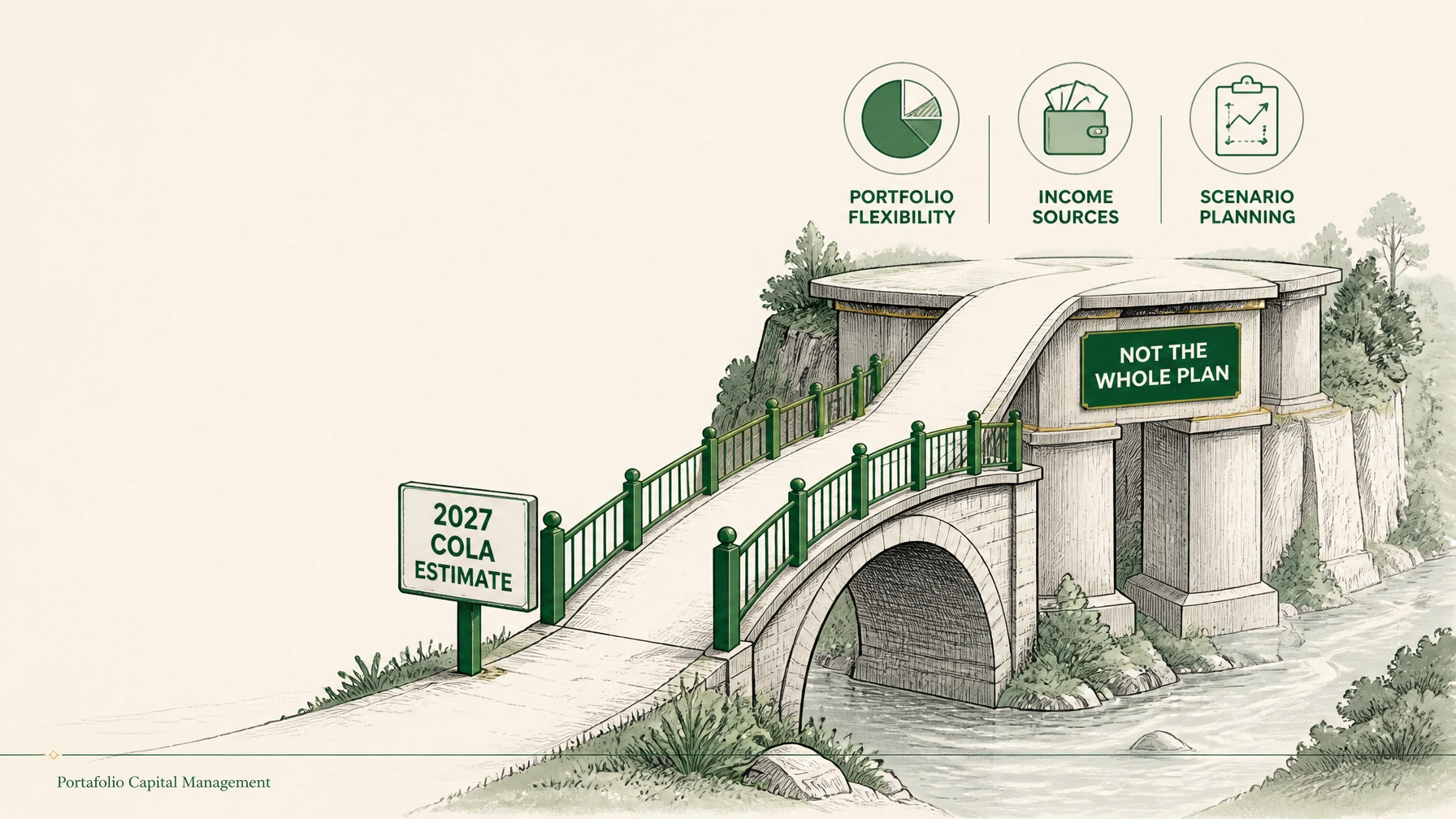
Image description: A dark green and cream editorial illustration shows a modest “2027 COLA Estimate” sign connected to a broader retirement planning path labeled “Not the Whole Plan.”
A projected Social Security cost-of-living adjustment can be useful for planning. It can help retirees estimate how their monthly benefit may change next year and provide a starting point for reviewing household cash flow.
But a projected annual increase is only one assumption.
As of September 2, 2026, the latest published estimates I could verify place the 2027 Social Security COLA between approximately 3.5% and 3.6%. The Senior Citizens League has estimated 3.6%, while AARP has published an estimate of 3.5%. These figures are not official. The final COLA will depend on inflation data that has not yet been fully released.
That distinction matters. A retirement plan built around one projected percentage can appear precise while remaining fragile.
What the current 2027 COLA estimate means
The Social Security Administration calculates the annual cost-of-living adjustment using the Consumer Price Index for Urban Wage Earners and Clerical Workers, commonly called CPI-W.
The formula compares the average CPI-W for July, August, and September with the comparable third-quarter average from the prior calculation period. The resulting increase is rounded to the nearest tenth of one percent.
For the 2027 COLA:
- July 2026 CPI-W data are available.
- August 2026 CPI-W data are scheduled for release on September 11, 2026.
- September 2026 CPI-W data are scheduled for release on October 14, 2026.
- The Social Security Administration is expected to announce the official 2027 COLA in October, after the required data are available.
Therefore, a 3.5% or 3.6% figure reported in early September is an estimate based on incomplete information. It may move higher or lower before the official announcement.
The 2026 COLA, by comparison, was officially set at 2.8%, according to the Social Security Administration. A 2027 adjustment in the mid-3% range would be larger, but the difference does not automatically solve a household’s retirement income challenges.
A COLA adjusts one income source
Social Security can be an important part of retirement income, but it is generally only one component of a larger financial picture.
A household may also rely on:
- Withdrawals from investment accounts
- Income from part-time work or a business
- Pension payments
- Cash reserves
- Rental or other personal income
- A spouse’s income or benefits
Each source behaves differently.
Social Security benefits receive an annual adjustment based on the statutory formula. Portfolio withdrawals depend on account values, investment returns, spending needs, and the timing of withdrawals. Work income may change unexpectedly. Cash reserves can provide flexibility, but they are finite.
This is why a COLA estimate should be treated as an input to a retirement plan, not as the plan itself.
A projected 3.6% increase may improve expected income, but it does not determine whether a retiree can comfortably meet long-term spending needs. It also does not answer how much should be withdrawn from a portfolio, which accounts should provide near-term income, or how the household should respond if markets decline.
Why income diversification matters
Income diversification means avoiding dependence on a single source of cash flow. In retirement, this is less about collecting as many income sources as possible and more about building flexibility.
For example, a retiree might coordinate:
- Social Security benefits for baseline household expenses.
- Portfolio withdrawals for discretionary spending and larger planned purchases.
- Cash reserves for near-term needs or periods of market volatility.
- Flexible spending decisions when circumstances change.
This structure can help reduce the pressure placed on any one source.
It may also make it easier to adapt. If portfolio values decline, a household may be able to adjust discretionary spending temporarily. If employment income continues longer than expected, portfolio withdrawals may be delayed. If expenses rise, the investment strategy and cash-flow assumptions may need to be reviewed.
No approach eliminates uncertainty. The purpose is to make the plan less dependent on one forecast being correct.

Image description: A clean financial infographic shows three retirement income planning layers labeled “Social Security,” “Portfolio,” and “Spending plan,” connected to a broader scenario-planning framework.
A simple example of the limitation
Suppose a retiree currently receives a hypothetical monthly Social Security benefit of $2,500.
If the final 2027 COLA were 3.6%, the gross monthly benefit would increase by approximately $90, before considering any other changes or deductions.
That additional amount could be meaningful. It might help cover part of a recurring bill or provide more room in the household budget.
However, readers should avoid treating a COLA estimate as a basis for tax planning or other individualized financial decisions. Questions about how benefit changes may affect a personal tax situation should be reviewed with a qualified tax professional.
The increase would not answer several important questions:
- Will the retiree’s investment portfolio support the desired withdrawal rate?
- How much of the portfolio is exposed to market volatility?
- Is enough liquidity available for large, irregular expenses?
- What happens if the official COLA is lower than the estimate?
- What happens if the portfolio declines during the same period?
- Can discretionary spending be adjusted without affecting essential needs?
The COLA estimate addresses only one part of the income equation. A sound retirement plan must consider the interaction between benefits, investments, spending, liquidity, and time horizon.
Scenario planning is more useful than precision
Many retirement projections use a single expected return, inflation assumption, or benefit estimate. That can make a plan easy to read, but it may give a false sense of accuracy.
Scenario planning takes a different approach. Instead of asking, “What will happen?” it asks, “How would the plan respond if conditions were different?”
For the 2027 COLA, a household might review several reasonable cases:
- The final COLA is close to the current 3.5% to 3.6% estimate.
- The final COLA is somewhat lower.
- The final COLA is somewhat higher, but portfolio returns are weak.
- Social Security rises as projected, while spending increases faster than expected.
- Investment markets decline early in retirement and withdrawals need to be adjusted.
The objective is not to predict the exact future. It is to understand which assumptions matter most and where the household has flexibility.

Image description: Three labeled paths, “Lower COLA,” “Estimated COLA,” and “Higher COLA,” converge toward a retirement horizon, illustrating the value of testing multiple assumptions.
Questions to review before relying on the estimate
A projected COLA may be worth incorporating into a retirement review, but consider the following questions first.
1. What percentage of essential expenses does Social Security cover?
If Social Security covers only part of essential expenses, the rest must come from other income sources or assets. The size of the projected adjustment may be less important than the overall gap.
2. How flexible is your spending?
Some expenses are difficult to change. Housing, insurance, healthcare, and basic living costs may require continued funding. Other expenses, such as travel or gifts, may be more adjustable.
Knowing the difference can help a household evaluate how it would respond to an unfavorable scenario.
3. How much portfolio risk is appropriate?
A retirement portfolio still needs to support long-term purchasing power, but it also needs to align with the household’s cash-flow needs and tolerance for volatility.
The right question is not whether a portfolio has the highest possible return potential. It is whether the overall risk is appropriate for the investor’s objectives, time horizon, and income requirements.
Portafolio Capital Management discusses this broader process through its approach to investment strategy and risk analysis.
4. What assumptions are you making about future increases?
A COLA is determined annually. One year’s adjustment does not establish a permanent pattern for future increases. Avoid treating the latest estimate as a guarantee of what benefits will be worth several years from now.
5. When was the last full plan review?
A retirement plan can become outdated as spending, employment, account balances, family circumstances, and market conditions change. Periodic reviews can help identify whether the portfolio and income strategy still match the household’s goals.
The main takeaway
The current 2027 Social Security COLA estimate of approximately 3.5% to 3.6% may be a helpful planning assumption, but it is not a retirement strategy.
The official number remains unknown until the Social Security Administration receives the complete third-quarter CPI-W data. More importantly, even the final COLA will affect only one part of a broader retirement income plan.
A stronger process considers multiple income sources, portfolio flexibility, spending priorities, liquidity, and a range of possible outcomes. If you have questions about how Social Security changes may affect your personal tax situation, consult a qualified tax professional. If you are approaching retirement or already retired, a conversation with a fiduciary financial adviser can help you evaluate how these pieces fit together without relying on a single forecast.
Schedule a retirement-planning conversation with Portafolio Capital Management, or call (512) 593-8380 to learn more.
Sources
- Social Security Administration: Cost-of-Living Adjustment Information
- Social Security Administration: Latest COLA
- Social Security Administration: COLA calculation provisions
- Bureau of Labor Statistics: Consumer Price Index
- Bureau of Labor Statistics: 2026 release schedule
- The Senior Citizens League: COLA Watch
- AARP: 2027 Social Security COLA estimate
Estimate information reflects publicly available projections reviewed as of September 2, 2026. The official 2027 COLA had not yet been announced as of that date.
Portafolio Capital Management LLC dba Mau Sanchez Capital is a Texas-registered investment adviser. This content is provided for informational and educational purposes only and does not constitute personalized investment advice, tax advice, legal advice, or a solicitation to buy or sell any security. Investing involves risk, including the possible loss of principal. Advisory services are provided only pursuant to a written advisory agreement. Past performance is not indicative of future results.
Leave a Reply