
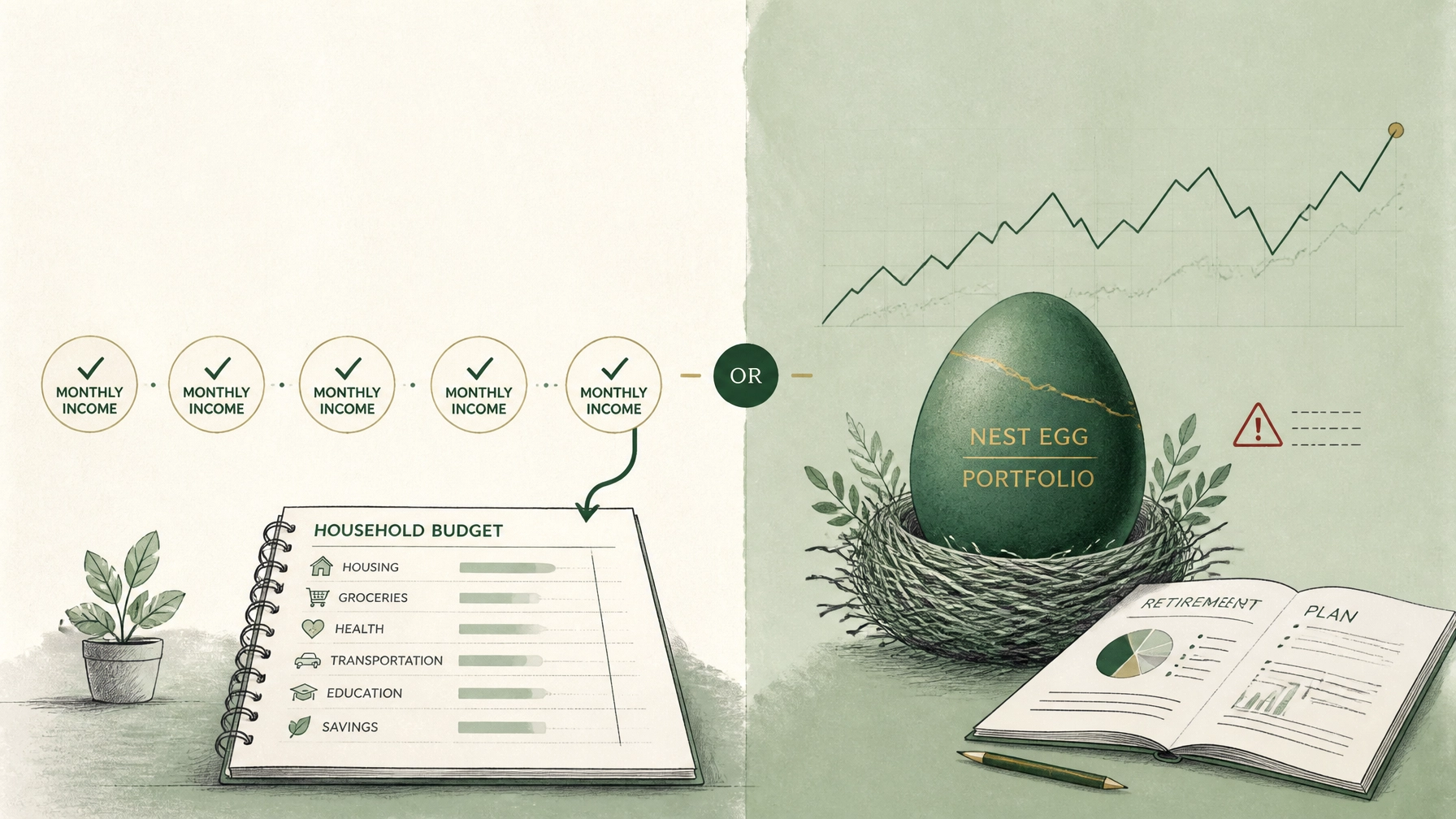
An editorial illustration representing the trade-off between predictable pension income and the flexibility of a lump sum.
A pension election can be one of the most consequential financial decisions you make as retirement approaches. In many plans, you may have to choose between receiving a lump-sum payment or collecting monthly payments for life.
The decision is not simply about which option offers more money. It involves longevity, income needs, liquidity, inflation, investment risk, spouse protection, and the financial strength of the organization responsible for paying the benefit.
There is no universally correct choice. The goal is to compare the options using assumptions that reflect your household’s retirement priorities and constraints.
What is the difference between the two choices?
A monthly pension typically provides a scheduled payment for the participant’s lifetime. Depending on the plan, payment options may include:
- A single-life benefit that ends when the participant dies
- A joint-and-survivor benefit that continues payments to a spouse
- A period-certain feature that guarantees payments for a stated period
- A cost-of-living adjustment, or COLA, that increases payments over time
A lump sum is a one-time payment representing the estimated current value of future pension payments. The amount is calculated using factors such as interest rates, mortality assumptions, the payment form selected, and the age when payments would begin.
Choosing the lump sum transfers more responsibility to the household. You would generally need to invest, withdraw, and manage the money in a way that supports retirement income over time.
The monthly pension transfers much of the investment and longevity risk to the pension plan or its payment provider. In exchange, you may have less control over the money and less flexibility for large expenses or estate goals.
1. Model longevity, not just life expectancy
A monthly pension becomes more valuable the longer it continues. This makes longevity one of the first factors to model.
Consider questions such as:
- What is your family history of longevity?
- How is your current health?
- How is your spouse’s health?
- Would you be financially prepared to live into your 90s or beyond?
- How much income would be needed if one spouse lives substantially longer than the other?
A lump sum may appear attractive if the value is viewed only through a short retirement period. But retirement planning often needs to account for a much longer horizon. If the lump sum is invested and withdrawn too aggressively, there is a risk that the money may not last for the household’s lifetime.
A monthly pension can help address that risk because payments continue according to the terms of the selected benefit form. However, the payment may not keep pace with rising expenses, and some forms may provide limited benefits after the participant’s death.
The comparison should therefore include several possible lifespans rather than relying on one expected age.
2. Compare the pension with actual income needs
The next question is how the pension fits into the household’s spending plan.
Separate expenses into categories such as:
- Essential expenses, including housing, food, utilities, and insurance
- Flexible expenses, including travel, hobbies, and gifts
- Irregular expenses, including vehicle replacement, home repairs, and family support
- Potential healthcare and long-term care costs
Then compare the pension option with other income sources, such as Social Security, part-time work, business income, or existing portfolio withdrawals.
A monthly pension may provide an important foundation for essential expenses. A lump sum may offer more flexibility for irregular or discretionary needs. Neither option should be evaluated in isolation from the rest of the household balance sheet.
For example, a household with several other dependable income sources may place a higher value on liquidity and control. A household that depends heavily on the pension for basic expenses may place greater value on predictable lifetime payments.
The important step is to determine which risks the household can absorb and which risks could significantly disrupt its retirement lifestyle.
3. Evaluate liquidity and flexibility
A monthly pension generally provides income but does not give you access to the underlying value as a large pool of capital. That can become important when retirement includes major expenses.
A lump sum may provide liquidity for:
- Paying off debt
- Funding a home purchase or relocation
- Supporting a business transition
- Covering a large healthcare expense
- Building a reserve for family needs
- Creating more control over withdrawal timing
Liquidity also has a potential cost. Money that is available can be spent, invested poorly, or exposed to decisions that were not part of the original retirement plan.
Model both the need for liquidity and the discipline required to manage it. A household may want flexibility, but it should also consider whether a large account balance would create pressure to make frequent withdrawals or react to market volatility.

Longevity planning requires comparing income needs and portfolio risks across multiple retirement time horizons.
4. Account for inflation and purchasing power
Inflation reduces the amount of goods and services that a fixed payment can purchase. Many traditional pensions do not include a COLA, although plan terms vary.
A $4,000 monthly payment may provide meaningful income when retirement begins. Over a long retirement, however, the same dollar amount may cover a smaller share of household expenses if prices continue to rise.
Review the pension documents carefully to determine:
- Whether payments increase over time
- Whether increases are tied to an inflation measure
- Whether increases are capped
- Whether the COLA applies to the entire payment or only part of it
- Whether survivor payments receive the same adjustment
A lump sum does not eliminate inflation risk. Its purchasing power depends on how the money is invested, withdrawn, and managed. Investments may provide the potential for long-term growth, but they also fluctuate in value and do not guarantee that withdrawals will keep pace with inflation.
A useful model can show how both choices perform under different inflation assumptions without treating any forecast as certain.
5. Measure investment and sequence-of-returns risk
With a lump sum, the household assumes responsibility for investment results. That includes the risk of market losses and the risk that poor returns occur early in retirement.
Sequence-of-returns risk is the danger that a portfolio experiences significant losses while withdrawals are being made. Two portfolios can earn the same average return over time, but the household that experiences losses earlier may have a more difficult recovery because it is selling investments to fund expenses.
A lump-sum analysis should test:
- Different investment return assumptions
- Market declines early in retirement
- Various withdrawal rates
- Changes in spending
- The amount held in liquid reserves
- How the portfolio would be managed during a downturn
A monthly pension can reduce the need to sell investments for the covered portion of household expenses. That may make the rest of the portfolio easier to manage, but the pension payment itself may have limited growth or inflation protection.
Portafolio Capital Management’s risk analysis approach emphasizes evaluating portfolio risk in relation to objectives, time horizon, and income needs. Those same principles can help organize a pension comparison.
6. Review spouse and survivor considerations
Married households should compare payment options using the needs of both spouses, not only the lifetime expectancy of the participant.
A single-life pension may provide a higher monthly payment while the participant is alive, but it may end at death. A joint-and-survivor option may provide continuing income to the spouse, often at a reduced monthly amount.
Important questions include:
- What income would the surviving spouse need?
- Would housing, insurance, or healthcare expenses change?
- Does the survivor payment continue for life?
- Is the survivor payment a percentage of the original amount?
- Would a lump sum provide a more flexible inheritance?
- How would the surviving spouse manage the investments?
Federal rules may require a qualified joint-and-survivor form of benefit for married participants in certain retirement plans unless the participant and spouse consent to another form. The IRS overview of retirement plan benefit types explains some of these payment and spousal-consent rules.
The plan administrator should provide the exact payment options and survivor provisions for your plan.

Spouse protection should be evaluated alongside income, liquidity, and legacy objectives.
7. Assess the financial strength of the payer
The organization responsible for the pension is another factor to review. For a private-sector defined benefit plan, determine whether the plan is covered by the Pension Benefit Guaranty Corporation, or PBGC.
PBGC protection is subject to legal limits and exclusions. It does not necessarily guarantee every dollar of every promised benefit. The PBGC explanation of pension coverage describes covered benefits and important limitations.
If a plan is terminated and transferred to PBGC, benefits may be subject to statutory maximums. PBGC publishes monthly maximum guarantee tables based on factors such as the plan termination year, the participant’s age, and the payment form.
If a plan transfers benefit obligations to an insurance company during a standard termination, future payments may depend on the insurer’s financial strength and applicable state protections rather than PBGC. The plan administrator can explain which structure applies.
This review does not mean a household should automatically favor one payment option. It means the source and strength of the payment promise should be understood before a decision is made.

Plan documents and payer protections are central parts of pension due diligence.
A practical way to compare the choices
Before making an election, request a written comparison showing:
- The lump-sum amount and calculation date
- Each available monthly payment option
- The starting age and payment commencement date
- Survivor benefits and any reductions
- COLA provisions, if any
- Payment guarantees and plan protections
- Whether the lump sum can be transferred directly to another retirement account
- The estimated income required from other assets under each choice
A financial model can then compare cash flow, longevity, inflation, investment returns, market losses, spouse needs, and legacy objectives.
Tax treatment is one factor that may affect the outcome, particularly if a lump sum is paid directly to you or transferred to another retirement account. The IRS provides general information on pension income and retirement plan distributions, but this article is not intended as tax advice. Households should consult a qualified tax professional for guidance based on their individual circumstances.
The key takeaway
The pension decision is a risk-allocation decision. A monthly payment can reduce investment and longevity risk but may limit liquidity and inflation protection. A lump sum can provide flexibility and control but requires disciplined investment management and a plan for generating income over a potentially long retirement.
Before choosing, model both options across realistic lifespans, spending needs, inflation assumptions, market conditions, spouse considerations, and payer protections.
If you would like to discuss how a pension decision fits into your broader retirement and investment plan, schedule a conversation with Portafolio Capital Management. You can also learn more about the firm’s investment strategy and portfolio management approach. A conversation can help clarify the broader planning questions to discuss with your plan administrator and qualified tax professional.
Sources
- Pension Benefit Guaranty Corporation: Pension Payment Options Overview
- Pension Benefit Guaranty Corporation: Understanding Your Pension and PBGC Coverage
- Pension Benefit Guaranty Corporation: Monthly Maximum Guarantee
- Internal Revenue Service: Types of Retirement Plan Benefits
- Internal Revenue Service: Publication 575, Pension Income and Retirement Plan Distributions
Portafolio Capital Management LLC dba Mau Sanchez Capital is a Texas-registered investment adviser. This content is provided for informational and educational purposes only and does not constitute personalized investment advice, tax advice, legal advice, or a solicitation to buy or sell any security. Investing involves risk, including the possible loss of principal. Advisory services are provided only pursuant to a written advisory agreement. Past performance is not indicative of future results.
Leave a Reply