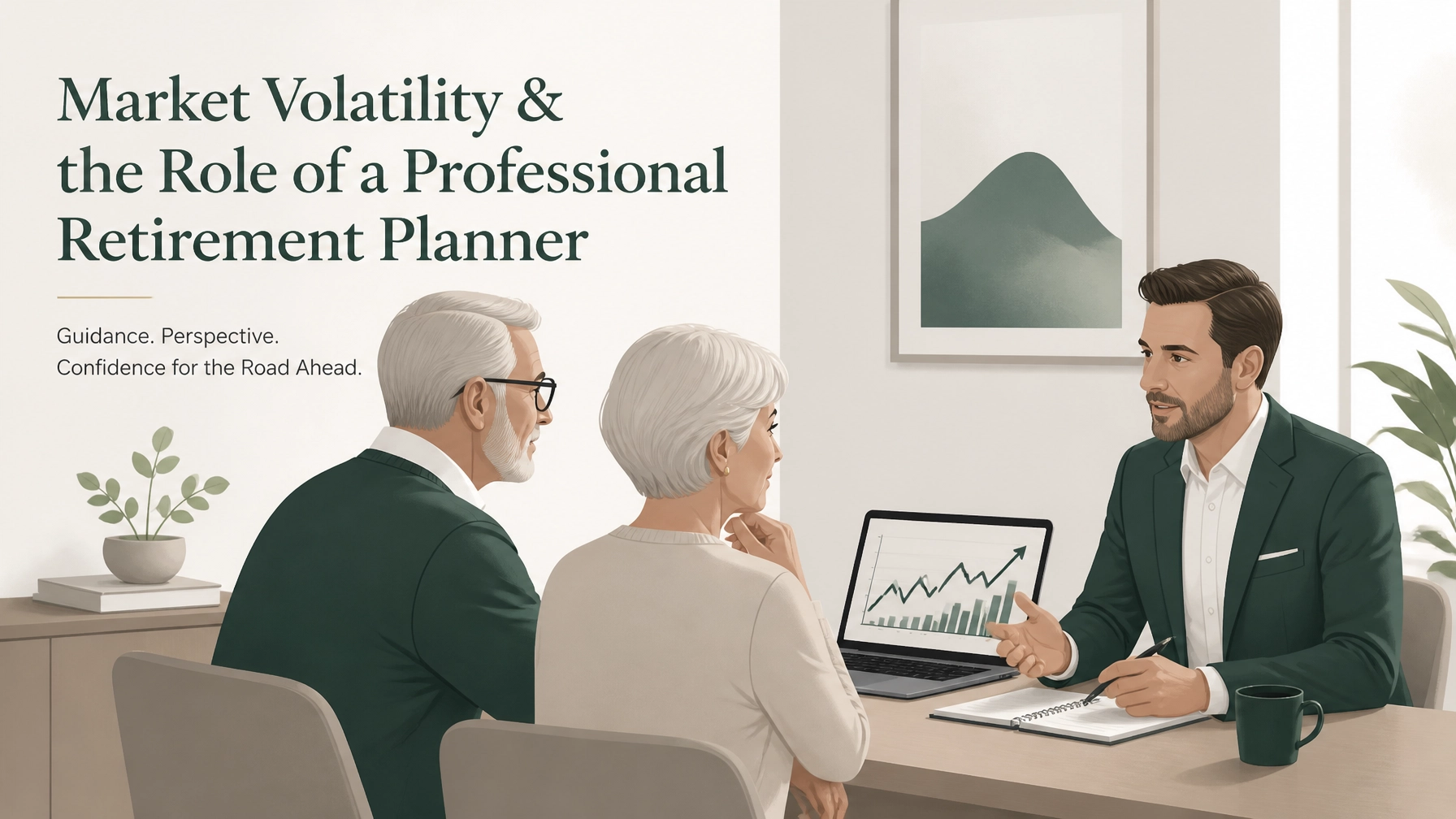
Market volatility represents one of the most significant threats to retirement security, yet most investors lack a structured framework for navigating downturns strategically. A professional retirement planner transforms volatility from a source of anxiety into a manageable component of a comprehensive income strategy.
The average intra-year stock market decline has been 14.3% since 1980, according to J.P. Morgan Asset Management research, yet the S&P 500 has delivered positive annual returns in 33 of those 44 years. This statistical reality reveals a fundamental tension in retirement planning. While short-term volatility is inevitable, long-term portfolio survival depends on how investors respond during those turbulent periods. For retirees and near-retirees, the stakes are higher because they face a specific risk that working professionals can largely ignore: sequence of returns risk.
The Fundamental Shift When Retirement Begins
During your accumulation years, market volatility actually works in your favor. When you contribute regularly to a 401(k) or IRA during a downturn, you purchase more shares at lower prices. This phenomenon, known as dollar-cost averaging, means that temporary market declines can enhance long-term returns for investors who are still adding money to their accounts.
Everything changes when withdrawals begin. Once you start drawing income from your portfolio, losses during the early years of retirement can permanently damage your financial security. The reason is mathematical: when you sell shares to generate income during a market downturn, those shares are gone. You cannot benefit when the market recovers because you no longer own those positions. Research from Morningstar demonstrates that retirees who experience poor market returns in their first five years of retirement face significantly higher risks of portfolio depletion, even if subsequent returns are strong.

This is where a professional retirement planner adds measurable value. Rather than reacting emotionally to CNBC headlines or making impulsive decisions based on short-term market movements, a strategic advisor helps structure your portfolio to account for sequence risk before it becomes a crisis.
Strategic Asset Allocation Beyond Simple Rules
The traditional advice to subtract your age from 110 to determine your equity allocation is dangerously oversimplified for retirement planning. A 65-year-old following this formula would hold 45% in stocks, but that calculation ignores critical factors like spending needs, income sources, legacy goals, and risk tolerance.
Professional retirement planners implement a more sophisticated approach. They segment your portfolio based on when you will need the funds. Money required for living expenses in the first two to three years of retirement should be positioned in stable, liquid assets like money market funds or short-term bonds. This creates a buffer that allows you to avoid selling equities during a downturn. Funds needed in years four through ten might be allocated to intermediate-term bonds and dividend-paying stocks. Assets intended for later retirement years or legacy planning can maintain higher equity exposure for growth potential.
This time-segmented strategy means that when the S&P 500 drops 20%, you are not forced to sell depreciated stock positions to pay for groceries. Instead, you draw from your stable income reserves while your equity positions have time to recover. According to research from Vanguard, this bucketing approach can reduce portfolio failure rates by up to 15% compared to static allocation models.
Coordination Across Multiple Income Sources
Most retirees receive income from several sources: Social Security, pensions, retirement accounts like 401(k) or TSP plans, and potentially part-time work or rental income. Each of these income streams has different tax implications, timing considerations, and optimization strategies. Coordinating these elements requires expertise that most individuals lack.

A professional retirement planner analyzes when to claim Social Security benefits based on your health, longevity expectations, and spousal considerations. Delaying Social Security from age 62 to 70 can increase your monthly benefit by 76%, according to the Social Security Administration, but that decision must be weighed against your need for current income and the opportunity cost of depleting other assets first.
Tax planning becomes equally critical. Withdrawals from traditional IRAs and 401(k) accounts are taxed as ordinary income, while Roth distributions are tax-free. Strategic Roth conversions during low-income years or after market downturns can significantly reduce lifetime tax liability. Professional advisors model these scenarios using specialized software that accounts for required minimum distributions, Medicare premiums, and tax bracket management across multiple decades.
The Behavioral Component of Volatility Management
Academic research consistently shows that individual investors underperform market indices by substantial margins, primarily due to behavioral mistakes. A 2019 study by DALBAR found that the average equity fund investor earned just 4.1% annually over a 20-year period, while the S&P 500 returned 6.1% annually during the same timeframe. This 2% annual gap compounds to devastating differences over retirement timelines.
The primary culprit is emotional decision-making during periods of volatility. Investors tend to sell after markets have already declined and buy after markets have recovered, systematically buying high and selling low. This pattern intensifies during retirement because the psychological impact of losses feels more threatening when you are no longer earning a salary.
A professional retirement planner serves as a behavioral buffer during volatile periods. When markets drop 15% and financial media amplifies panic, your advisor reminds you of your long-term plan and helps you distinguish between temporary market noise and fundamental changes that warrant action. This guidance is not motivational platitudes. It is strategic perspective grounded in historical data and your specific financial plan.

According to Vanguard research, investors who work with professional advisors achieve approximately 3% higher net annual returns compared to self-directed investors, primarily through behavioral coaching and asset allocation guidance. Over a 30-year retirement, this performance difference can mean the difference between portfolio longevity and running out of money.
Dynamic Rebalancing and Portfolio Adjustments
Market volatility creates rebalancing opportunities that can enhance long-term returns. When stocks decline sharply, your portfolio becomes overweight to bonds relative to your target allocation. Rebalancing by selling bonds and buying stocks during this period forces you to buy equities when they are depressed, which is precisely when long-term value is created.
However, rebalancing during retirement requires more nuance than during accumulation. You must balance the benefits of buying stocks at lower prices against the need to maintain adequate stable reserves for near-term spending. Professional retirement planners use systematic rebalancing frameworks that account for spending needs, tax consequences, and market conditions.
Additionally, your retirement plan should not remain static. Life circumstances change, market conditions evolve, and your income needs shift over time. Regular reviews ensure that your asset allocation, withdrawal strategy, and tax planning remain aligned with your current situation. Most professional advisors recommend quarterly or semi-annual portfolio reviews, with more frequent communication during periods of significant market volatility or personal life changes.
When Professional Guidance Matters Most
The five years before retirement and the first decade of retirement represent the most critical period for portfolio management. This window, often called the retirement red zone, is when sequence of returns risk is most acute and when poor decisions can cause irreversible damage to your financial security.

During this period, a professional retirement planner helps you transition from accumulation strategies to income generation strategies. This transition involves more than simply shifting from growth stocks to bonds. It requires comprehensive planning around Social Security timing, pension elections, required minimum distribution strategies, tax-efficient withdrawal sequencing, healthcare cost planning, and estate considerations.
Market volatility during this critical window demands professional expertise. According to a study by the Stanford Center on Longevity, retirees who work with financial advisors during their transition into retirement have significantly higher portfolio survival rates compared to those who attempt to navigate this period independently.
Building Confidence Through Structure
The ultimate value of working with a professional retirement planner during volatile markets is confidence. When your asset allocation is strategically designed, your income sources are properly coordinated, and your spending plan accounts for market fluctuations, volatility becomes something you planned for rather than something that derails your retirement.
This confidence is not about predicting market movements or timing the perfect entry and exit points. It is about having a comprehensive strategy that can withstand various market environments. When you know that your next three years of spending needs are secure in stable assets, a 20% stock market decline becomes a temporary inconvenience rather than a financial emergency.
Professional retirement planners provide the structure, expertise, and behavioral guidance that transforms market volatility from a threat into a manageable component of long-term wealth preservation. The question is not whether markets will be volatile during your retirement. They will be. The question is whether you have the strategic framework to navigate that volatility successfully.
Portafolio Capital Management is an independent wealth and capital management firm based in San Antonio, Texas. With over 12 years of combined investment and macro-economic analysis experience, our goal is to instill confidence in our investors through how we view markets and our investment approach. As a Registered Investment Advisor (RIA) and fiduciary, we are held to the highest standard when it comes to managing your money and are bound by law to act solely in your best interest. Learn more about our strategy and management style by scheduling a 15-minute warm meeting at: https://calendly.com/portafoliocapital/15min. Ready to speak to a independent financial advisor today? Give us a call at (512) 593-8380.
All content is not to be received as financial advice and is for informational purposes only. Each individual should consult with their dedicated financial advisor, tax preparer, estate attorney, etc. before making any financial or investment decisions. Portafolio Capital does not recommend (nor does it make recommendations of) the buying or selling of any securities through any of our published content mediums. We expressly disclaim and do not assume any liability in connection with any inaccuracies in any of the information provided or in connection with information stated. While we do our best to vet thoroughly and provide you with information from reputable resources, not limited to: FRED, Yahoo Finance, CNBC, and company specific investor websites, unfortunately we cannot guarantee the accuracies of such and ask that you do your own due diligence when researching any finance, economics, and earnings information. Furthermore, we do not undertake an obligation to update or revise publicly any information as it changes. Please read our entire legal disclaimer page at portafoliocapital.com/disclosures-and-document.
Leave a Reply